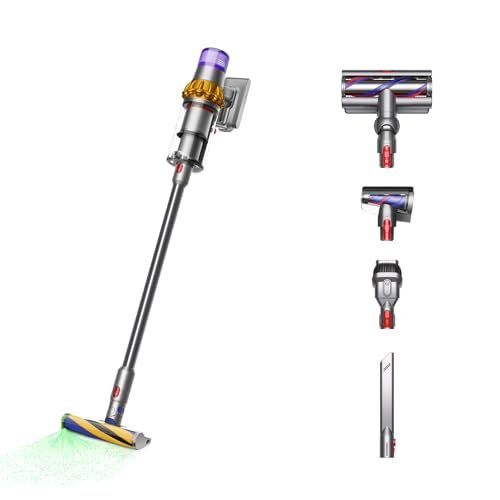
Cordless stick vacuums have come a long way from the underpowered models of a decade ago. The big question most shoppers face now is not whether to cut the cord, but whether a flagship model like the Dyson V15 Detect Plus is worth it — or whether a cheaper stick vacuum will do the job just as well for their home.
The Dyson V15 Detect Plus sits near the top of Dyson’s cordless lineup, and its headline features read like something out of a lab: a green laser that reveals microscopic dust on hard floors, a piezo sensor that counts the particles you vacuum up, and an LCD screen that shows the results in real time. It’s an impressive pitch — but the real question is whether those smarts translate into a cleaner home or just a cleaner-looking spec sheet.
In this guide, we break down what the Dyson V15 Detect Plus does well, where it falls short, and who should (and shouldn’t) consider it — based on the published specs, independent lab measurements, and owner feedback.
Quick Verdict: Is the Dyson V15 Detect Plus Worth It?
For most households that want one vacuum to handle hard floors and carpet, the Dyson V15 Detect Plus is worth it if you value deep-cleaning performance, the dust-revealing laser, and whole-machine HEPA filtration. It’s best for pet owners, allergy sufferers, and anyone with hard floors who wants proof — right on the LCD screen — that the floor is actually clean.
The one main caveat: this is a premium, relatively heavy machine whose 60-minute battery claim only applies to Eco mode. If you have a large home, mostly run it on Boost, or find 3+ kg vacuums tiring, the value equation gets harder to justify.
What Makes It Worth Considering?
Laser dust detection that actually changes how you clean
The Slim Fluffy Optic cleaner head projects a precisely angled green laser that makes microscopic dust visible on hard floors — dust you would otherwise never see. Owners consistently describe this as the standout feature: it turns invisible debris into something you can see and target. Effectiveness depends on ambient lighting and floor type, but in dimmer rooms the effect is striking.
A piezo sensor and LCD screen that show what’s being picked up
An acoustic piezo sensor counts and sizes dust particles as they enter the vacuum, and the LCD screen displays the results as a live bar graph by particle size, plus remaining run time and the current power mode. It also alerts you to blockages. In Auto mode, the vacuum uses this data to adjust suction on its own — ramping up on dirty carpet and easing off on clean hard floors.
Flagship suction with whole-machine HEPA filtration
Dyson rates the Hyperdymium motor at up to 240 air watts of suction, with Root Cyclone technology maintaining consistent power as the bin fills. The sealed, whole-machine HEPA filtration system traps 99.99% of particles as small as 0.3 microns and expels cleaner air — a meaningful benefit for allergy and asthma households, since a sealed system keeps fine dust from leaking back into the room. (Note: confirm the specific bundle you buy includes the HEPA configuration, as Dyson ships some V15 bundles without it.)
Purpose-built heads for hard floors and carpet
The two main cleaner heads serve distinct jobs: the Fluffy Optic head for delicate hard floors and the Digital Motorbar head for carpet, with de-tangling teeth that strip hair off the brush bar. The Plus bundle also includes a Hair screw tool designed specifically for pet hair — one of the most praised accessories among pet owners.
Converts to a handheld and empties hygienically
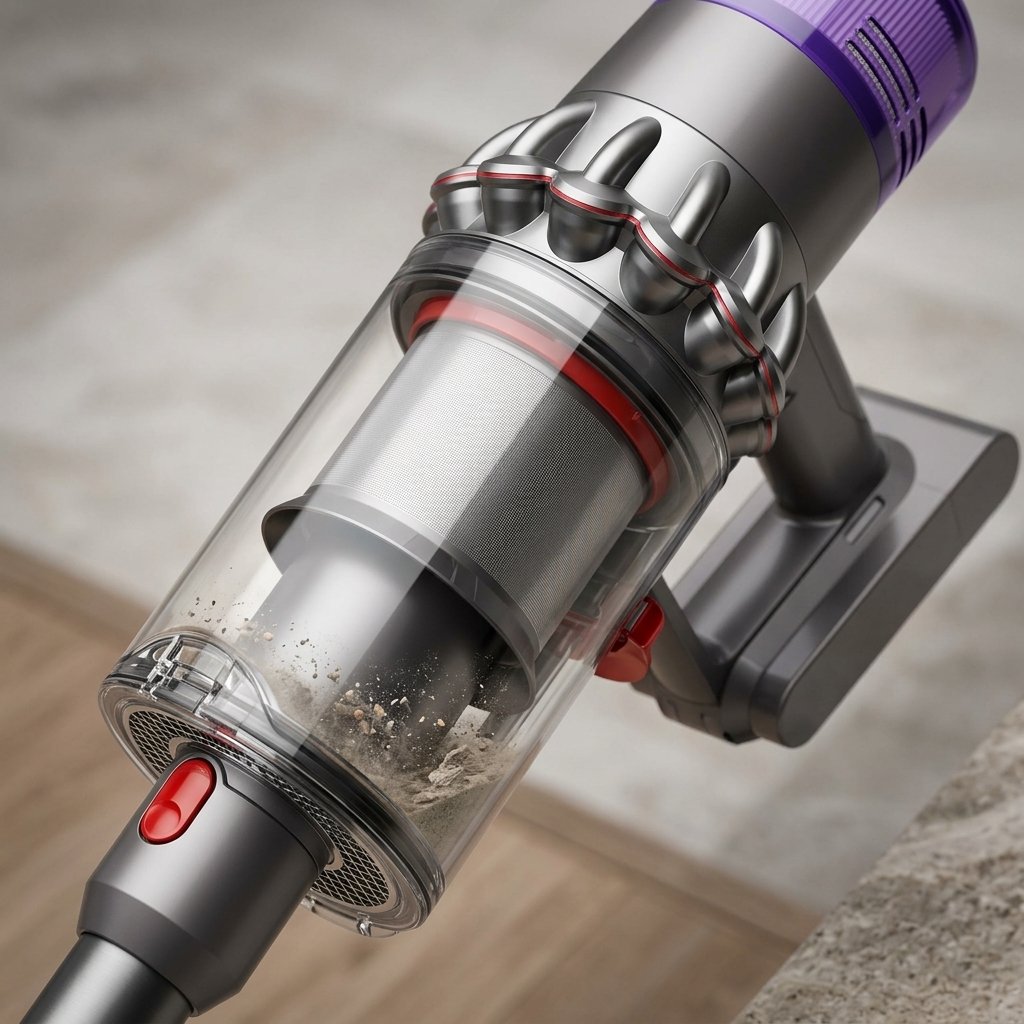
The stick converts to a handheld with one click for stairs, upholstery, cars, and mattresses, and the included mini soft dusting brush and crevice tool cover the usual tight spots. The 0.77-liter bin — larger than many competitors’ — empties with a single sliding motion that keeps dust away from your hands.
What Could Be Better?
- The battery math is mode-dependent. Dyson’s “up to 60 minutes” figure applies to Eco mode without a motorized tool. In Boost mode, independent testing shows run time drops to roughly 5–10 minutes — fine for spot-cleaning, but not enough to clean a whole house at maximum suction.
- It’s heavy for a stick vacuum. At around 3.1 kg (6.8 lbs), the V15 sits at the upper end of comfortable for overhead or extended cleaning. Long sessions can tire your wrist and arm, especially on stairs.
- Premium positioning with diminishing returns for average homes. If you have typical carpeting and minimal pet hair, mid-range cordless vacuums clean standard debris nearly as well for much less. The V15’s advantages show most clearly in homes with pets, heavy shedding, or allergy concerns.
- Battery and trigger gripes. The trigger-style power switch requires continuous pressure, which some owners find fatiguing. Sustained high-power use over a couple of years can degrade the battery noticeably, and replacement batteries are a meaningful extra cost not covered by the warranty.
Who It’s For — and Who Should Skip It
It’s a strong pick if you…
- Own pets and fight a constant battle with hair and dander — the Hair screw tool and Motorbar de-tangling head were made for this.
- Have allergies or asthma and want sealed, whole-machine HEPA filtration with expelled air that’s cleaner than what went in.
- Have mostly hard floors and want the laser to make sure you’re not missing fine dust.
- Like data: the LCD particle counts and adaptive Auto mode give visible feedback that cleaning is working.
Skip it if you…
- Live in a large home and mostly clean at maximum power — the Boost-mode run time won’t get through it on one charge.
- Have limited arm strength or mobility issues — lighter stick vacuums exist for less.
- Just need basic whole-home maintenance cleaning — a mid-range model covers standard debris well enough.
How It Compares to Alternatives on RealTruePick
If the V15 Detect Plus feels like too much vacuum, Dyson’s own lineup on our site offers two step-downs. The Dyson V8 Stick Vacuum is the budget-friendly classic: lighter and simpler, with no laser or particle-counting LCD, but still a capable everyday cleaner for smaller homes. The Dyson V15 Detect — the non-Plus sibling — shares the core laser-and-LCD technology with a slightly different bundle of tools, so it’s worth comparing if you don’t need the Plus bundle’s extras like the Hair screw tool. For a broader framework, see our guide to choosing the right vacuum cleaner, and if you’d rather automate the job entirely, our robot vacuum guide.
Dyson V15 Detect Plus Worth It — Frequently Asked Questions
What’s the difference between the Dyson V15 Detect Plus and the V15 Detect?
They share the same core technology — the Hyperdymium motor, laser dust detection, piezo sensor, and LCD screen. The differences are in the bundle: the Plus version ships with extra accessories (notably the Hair screw tool) and the sealed whole-machine HEPA filtration configuration. Compare the specific bundle contents before buying, since tool counts vary by retailer.
How long does the battery really last?
Up to 60 minutes in Eco mode without a motorized attachment. In Auto mode with the cleaner head attached, expect a middle-ground figure, and in Boost (maximum) mode, independent tests show roughly 5–10 minutes. Charging from empty takes about 3.5–4 hours.
Is the laser dust detection just a gimmick?
Most owners say no — on hard floors, the green laser genuinely reveals fine dust that’s invisible under normal light, and it tends to make people clean more thoroughly. Its effectiveness depends on ambient light (it works best in dimmer rooms) and floor type; it’s designed for hard floors, not carpet.
Can the V15 Detect Plus replace a full-size upright vacuum?
For many homes, yes — it handles hard floors and carpet well, converts to a handheld, and empties hygienically. But large homes or heavy-duty carpet cleaning may still benefit from a second battery, or from a robot vacuum running daily maintenance passes.
As an Amazon Associate I earn from qualifying purchases.