
A dead battery rarely announces itself. One cold morning, one forgotten dome light, one aging cell past its prime — and your car simply won’t start. A portable jump starter is the small device that turns that disaster into a minor inconvenience: a pocket-sized battery pack that can crank your engine back to life in minutes, no second car or stranger with cables required. Learning how to choose a portable jump starter comes down to a few specs that actually matter and several that don’t, and getting them right means you’ll never be stranded again.
Quick answer: Choose a portable jump starter with peak amps rated for your engine size — around 1,000A covers most 4- and 6-cylinder gas engines, while V8s and diesels need 2,000A or more. Prioritize spark-proof, reverse-polarity-protected clamps and a reputable brand over the biggest amp number on the box. A model that doubles as a USB power bank is genuinely useful; extras beyond that are optional.
Match Peak Amps to Your Engine Size
The single most important decision when choosing a portable jump starter is matching its power to your vehicle. Bigger engines — and diesel engines in particular — need a bigger surge of current to turn over, and an undersized pack may click, stall, or shut down on overload without ever starting the car.
Use these rules of thumb:
- Small 4-cylinder gas engines (up to ~2.5L): 400–1,000 peak amps is plenty. This covers most compact cars, motorcycles, ATVs, and lawn equipment.
- V6 and mid-size engines (2.5L–4.0L gas): aim for 1,000–1,500 peak amps. This is the most common bracket for sedans and crossovers.
- V8 gas and small diesel engines (4.0L–6.0L): you need 1,500–2,000 peak amps or more.
- Large trucks, RVs, and heavy-duty diesels: look for 2,000+ peak amps.
Diesels demand more current than gas engines of the same size because of their higher compression ratios, so diesel drivers should always size up. The same goes if you live where winters get cold: cold thickens engine oil and saps battery output, so a pack that starts your engine fine in spring may struggle at freezing temperatures. Buying one size larger than the minimum is cheap insurance.
Note that sizing is only ever “upward”: the jump starter delivers only the current your starter motor demands, so a bigger pack won’t harm a small car. It just gives you headroom for cold mornings, deeply discharged batteries, and your next, larger vehicle.
Understand Peak Amps vs. Real Starting Power
Peak amps are a burst, not a guarantee
Peak amps — the number printed largest on every box — measure the maximum burst of current a pack can deliver in a short pulse, sometimes only milliseconds. Manufacturers highlight it because it looks impressive, but it doesn’t guarantee the engine will turn over.
Look at sustained current too
Cranking amps (CA) or cold cranking amps (CCA) describe sustained current delivery and are a better indicator of real starting capability, especially for larger or cold-soaked engines. A pack rated 2,000 peak amps might deliver only a fraction of that continuously — and a brand that publishes honest, third-party-verified output numbers is worth more than a no-name brand claiming an astronomical peak figure.
The practical takeaway: compare packs within the same peak-amp class by brand reputation and verified reviews rather than chasing the highest number. A well-built 1,000A unit from a trusted brand starts more real cars than a dubious 6,000A generic pack with thin cables.
Cables and clamps matter as much as the box
Even the best battery cell is useless behind flimsy cables. Look for heavy-gauge, reasonably long cables and solid metal clamps that grip battery terminals firmly. Short, stiff, thin cables are a common complaint on cheap packs and make connection in a cramped engine bay a real chore.
Safety Features Every Portable Jump Starter Needs
Modern lithium jump starters are dramatically safer than old lead-acid boost boxes, but only if they include the right protections. These are non-negotiable:
- Reverse-polarity protection — connecting clamps the wrong way won’t damage your car or spark.
- Spark-proof circuitry — no current flows until a correct connection is confirmed, eliminating sparking near the battery.
- Over-voltage, over-current, and short-circuit protection — guards your vehicle’s electronics, which are far more expensive than the pack.
- Over-temperature protection — shuts the unit down before thermal problems start.
Reputable brands like NOCO build all of these into their “mistake-proof” clamp systems. If a listing doesn’t clearly describe its protection systems, skip it — protecting your car’s computer is worth more than any amp rating.
Extras That Are Actually Worth It
Most portable jump starters come as a small kit with clamps, a carrying case, and a charging cable. Beyond that, a few extras are genuinely useful:
- USB power bank output — almost every lithium pack can charge your phone, and it’s the feature you’ll use most between emergencies. A pack with fast-charging USB is ideal for road trips — see also our guide to choosing the right USB charger.
- LED flashlight with strobe/SOS modes — changing a connection in the dark is exactly when you’ll appreciate this.
- Charge indicator display — takes the guesswork out of knowing whether the pack is ready; recharge it if it sits below ~75%.
- Built-in air compressor or 12V output — nice for tires and camping gear, but they add bulk. Decide whether you want a slim emergency tool or a multi-tool.
Skip gimmicks you won’t use. The best portable jump starter is the one that’s charged and in your glovebox when you need it, so compact size and a long shelf charge matter more than novelty features.
Cold Weather and Battery Care Tips
A jump starter is only helpful if it holds its charge. Lithium packs lose charge slowly over months, and extreme cold weakens their output:
- Recharge your pack every 3–6 months, or after any jump. A 10-minute top-up habit keeps it ready.
- Store it at room temperature when possible; on very cold mornings, warming the pack inside your jacket for a few minutes before a jump can help.
- After a successful jump, drive for at least 20–30 minutes so the alternator recharges your car’s battery — the pack only revives it once.
- If your battery needs a jump every few days, it’s worn out. No portable jump starter replaces a failing battery; get the battery tested and replaced.
Our Picks
- NOCO Boost Plus GB40 — 1,000 peak amps, rated for gas engines up to 6.0L and diesels up to 3.0L. Up to 20 jump starts per charge, doubles as a USB power bank, with a 100-lumen LED flashlight and spark-proof clamps. The right pick for most sedans, crossovers, and everyday drivers who want a compact glovebox kit.
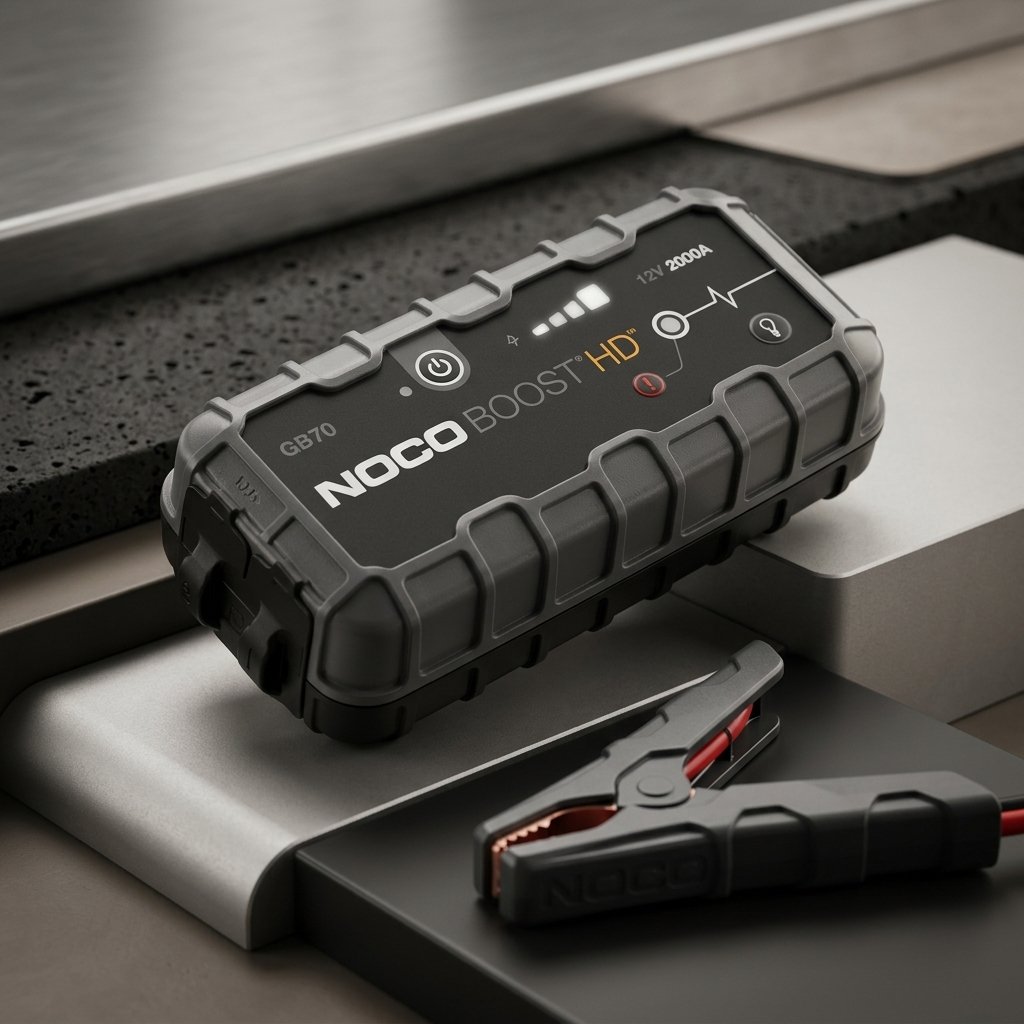
- NOCO Boost HD GB70 — 2,000 peak amps for gas engines up to 8.0L and diesels up to 6.0L. Up to 40 starts per charge, dual USB outputs, and a 400-lumen flashlight. The step-up choice for V8s, diesel trucks, RVs, and cold-climate drivers who want maximum headroom.

For more roadside preparedness, see our guide on choosing the right dash cam.
Frequently Asked Questions
Will a portable jump starter damage my car’s electronics?
No — as long as it has reverse-polarity and spark-proof protection, which any reputable unit does. The pack only delivers current when the clamps are correctly connected, and modern protections shield your vehicle’s computer systems.
How long does a portable jump starter hold its charge?
Most lithium packs hold a usable charge for 6–12 months in storage, but topping them up every 3–6 months is the safe habit. Check the charge indicator before long road trips or winter.
Can I use a jump starter on a diesel engine?
Yes, provided the pack is rated for it — diesels need more current, so choose a pack rated for your engine’s displacement in liters, and size up if you drive in cold weather. A 2,000A-class pack like the NOCO Boost HD GB70 covers most light diesel trucks.
What’s the difference between a jump starter and a battery charger?
A portable jump starter delivers a quick burst to start a dead engine; a battery charger or maintainer slowly recharges a battery over hours. Jump starters are for emergencies on the road — if your car sits unused for weeks, a maintainer keeps the battery from dying in the first place.
As an Amazon Associate I earn from qualifying purchases.