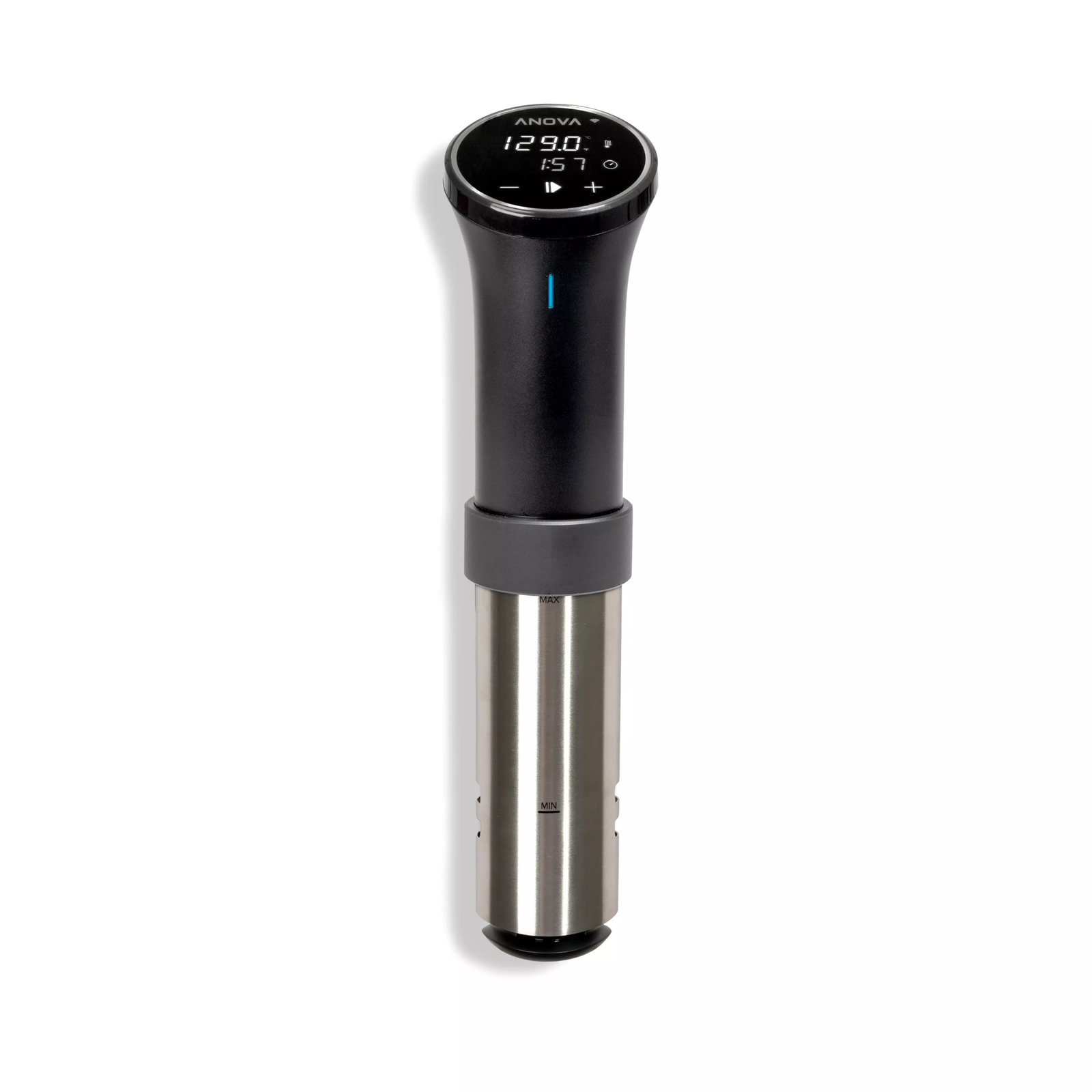
Sous vide sounds like a restaurant technique, and for a long time it was. A circulator heats a water bath to an exact temperature, you seal food in a bag, and the water cooks it gently and evenly — no hot spots, no guesswork, no overcooked edges. Today, a good home circulator costs about as much as a mid-range blender, and it turns out steakhouse results at home are mostly a matter of picking the right machine. Learning how to choose a sous vide cooker comes down to a handful of specs that genuinely matter, and a few marketing claims you can safely ignore.
Quick answer: For most home cooks, the right sous vide cooker is an immersion circulator with 1,000 to 1,100 watts of power, temperature accuracy within about 0.2°F, a temperature range that reaches down to 32°F, and controls you can use without a phone. Pick a model that clamps securely to your pot, and pair it with a lidded container for long cooks — those two details matter more than any app feature.
What Is Sous Vide, and Why Does It Work So Well?
Sous vide means “under vacuum” in French, and the name describes the method: food goes into a sealed bag, the bag goes into a water bath held at a precise temperature, and the food can never get hotter than the water around it. Set the bath to 130°F for a medium-rare steak, and the steak simply cannot cross 130°F, no matter how long it stays in.
That ceiling is what makes the method so forgiving. Water carries heat far better than air, and a circulator keeps the water moving so every corner of the bath sits at the same temperature. The result is edge-to-edge doneness — a steak that is pink from surface to surface instead of gray at the edges and pink only in the middle.
It also explains why exact temperature matters. Proteins firm up at specific thresholds: fish begins to set around 104 to 122°F, land-animal muscle around 122 to 140°F, and the tough collagen in cheaper cuts only melts into gelatin once it holds above roughly 154°F for a long stretch. A circulator that drifts by a degree or two will not ruin a 20-hour pork shoulder, but it decides whether a soft-cooked egg comes out runny or jammy.
One thing sous vide does not do is brown food. A steak that comes out of the bath looks pale and unappetizing until you sear it — 30 to 60 seconds per side in a ripping-hot cast iron skillet, or a quick pass with a kitchen torch. Plan for that step, and budget for a skillet if you do not already own one.
How to Choose a Sous Vide Cooker by Wattage
Wattage decides how fast the bath heats up and how quickly it recovers when you drop in cold food. For home use, the sweet spot is 800 to 1,200 watts.
- 800 to 900 watts is enough for a small pot and one or two portions, but heat-up times stretch out and the bath recovers slowly after you add a cold roast.
- 1,000 to 1,100 watts is the right range for most kitchens. A 1,100-watt circulator handles a 10- to 15-liter bath comfortably — steaks, chicken breasts, a whole pork tenderloin, or vegetables for a family dinner.
- 1,200 watts and up makes sense if you regularly cook large roasts, several racks of ribs, or whole turkeys, or if you want the fastest possible heat-up in a big covered container. Anova also sells a 1,600-watt Pro version for very large baths, which is more machine than most home cooks need.
Do not overthink this number beyond that. Once a bath is up to temperature, maintaining it takes very little power, so wattage mostly buys you patience back at the start of the cook.
How to Choose a Sous Vide Cooker by Temperature Accuracy
Accuracy is the whole point of sous vide, so read this spec before any other. The gold standard for home circulators is accuracy within about ±0.1°C (0.2°F) of the set temperature, and most quality machines now hit it. Anything rated worse than about ±0.5°C will cook inconsistently with delicate foods like fish and eggs.
Equally important is circulation. A strong pump keeps the bath uniform, so look for a published flow rate — around 8 liters per minute is typical for a good home circulator — and a design that moves water in all directions rather than in a single jet. Without even circulation, one side of the bath can run a degree warmer than the other, and the whole point of the method is lost.
When your cooker arrives, check it once against an instant-read thermometer. If it always reads a degree off, just adjust your setting to match. Some models also let you calibrate the offset directly, which is a nice feature for serious cooks but not a requirement.
Temperature Range: Look for 32°F at the Bottom
Most circulators top out around 197°F, which covers everything from delicate fish to high-temperature vegetables. The bottom of the range matters more than people expect. A cooker that goes down to 32°F can also run an ice bath — useful for thawing frozen food safely and for chilling cooked food quickly before refrigerating it.
Some app-only models bottom out around 68°F, which means they cannot do ice baths at all. If you want one machine that thaws, chills, and cooks, make sure the range starts at 32°F.
Controls: Onboard Display vs. App-Only
You will use the controls every time you cook, so this choice is practical, not cosmetic.
- Onboard display and buttons let you set time and temperature directly on the cooker. This is the safer choice: the machine works even if your Wi-Fi is down, your phone is dead, or the app changes its pricing.
- App control over Wi-Fi or Bluetooth is genuinely handy for long cooks. You can start a 24-hour brisket from the office, get a notification when the bath reaches temperature, and check progress from another room.
- App-only models have no display at all — one button on the device, everything else in the app. They tend to be smaller and quieter, and the apps are often excellent, but you are entirely dependent on the phone. Some manufacturers now charge a subscription for premium app features, while basic control stays free, so check the app economics before you buy.
For most buyers, the best setup is both: a clear two-line touch display on the cooker, plus an app you can use or ignore. That combination is exactly what the Anova Precision Cooker 3.0 offers, and it is why it is the default recommendation in so many buying guides.
Container, Clamp, and Everyday Practicalities
A circulator clamps to a container, and the container matters almost as much as the machine. Any deep stockpot works for short cooks, but for long cooks a dedicated polycarbonate container with a fitted lid is worth owning. A lid cuts evaporation dramatically — over a 24-hour cook, an open pot can lose enough water to trigger a low-water shutoff — and it keeps the bath temperature stable.
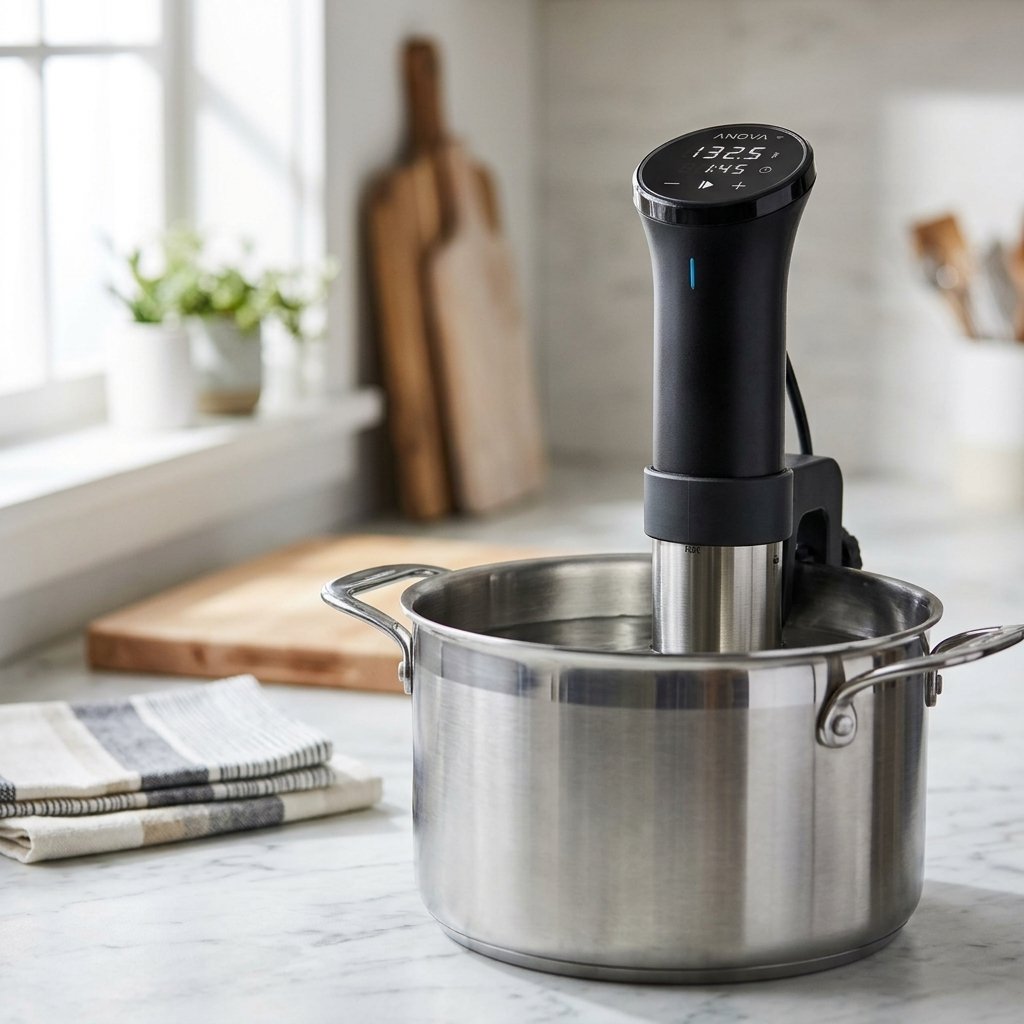
Check these details before you buy:
- The clamp should grip your pot or container firmly and adjust to different wall thicknesses. A wobbly clamp is the most common everyday annoyance in sous vide cooking.
- Size and storage matter in a small kitchen. Most home circulators are about 13 inches tall; make sure yours fits in a drawer or stands upright in a cabinet.
- Cleaning should be simple. A removable sleeve or skirt lets you rinse the heating element and impeller after a cook, which keeps mineral buildup from shortening the machine’s life.
- Water resistance is worth checking if you cook near a sink. An IPX7 rating means the cooker survives being dunked, which is reassuring insurance rather than a feature you will test on purpose.
- Noise is a real consideration for overnight cooks. A quiet brushless motor running under 40 decibels will not disturb the household; a loud one will.
You will also need bags. Vacuum-sealed bags are the standard, but the water-displacement method — lowering a zip-top bag into the water so the pressure pushes the air out — works well for most foods and costs nothing extra.
Food Safety Basics You Should Know
Sous vide is safe when you follow the temperature rules, and the rules are simple. The USDA’s safe-temperature guidance still applies: hold food long enough at temperature and sous vide pasteurizes as it cooks. But a bath below about 130°F is a holding zone, not a safe long cook — do not hold food for hours at temperatures under 130°F.
Two habits cover most of the risk. First, use the time-and-temperature combinations published by a trusted source for the food you are cooking, rather than guessing. Second, chill cooked food quickly in an ice bath before refrigerating it if you are not eating it right away. A circulator that reaches down to 32°F makes that second step easy, since the same machine can run the ice bath.
Our Picks
- Anova Precision Cooker 3.0 — The all-rounder for most home kitchens: 1,100 watts, 32°F to 197°F with ±0.2°F accuracy, an 8-liter-per-minute flow rate, dual-band Wi-Fi and Bluetooth, and a two-line touch display so you can cook with or without the app. The adjustable clamp fits most pots, and the sleeve comes off for easy cleaning.
Frequently Asked Questions
Do I need a vacuum sealer for sous vide cooking?
No. A vacuum sealer is convenient and gives the most reliable seal, but the water-displacement method with a sturdy zip-top bag works well for most foods. Start with zip-top bags and add a sealer later if you cook sous vide every week.
How long does sous vide cooking take?
Longer than a skillet, and that is the point. A steak takes 1 to 2 hours, chicken breasts about 1 to 1.5 hours, and tough cuts like brisket or pork shoulder take 24 to 48 hours. The extra time is mostly hands-off, and the food cannot overcook while it waits.
Can I sous vide frozen food?
Yes, and it is one of the method’s best tricks. Add about 50 percent more time to the cook, and make sure the bag is fully submerged. A circulator that reaches down to 32°F can also thaw food in an ice bath before you start cooking.
Is sous vide worth it if I only cook steak occasionally?
If you cook steak or chicken even a few times a month, a circulator pays for itself in consistency alone — no more guessing, no more overcooked edges. If you rarely cook meat at home, a simpler tool like an electric pressure cooker may be a better first purchase, and our electric pressure cooker guide covers that option in detail.
As an Amazon Associate I earn from qualifying purchases.