
A tower fan is the easiest way to make a warm room feel comfortable without installing anything or giving up floor space. It stands in a corner, pushes a steady column of air across the room, and costs far less to run than an air conditioner. But not every tower fan cools equally well. The wrong one leaves hot spots, hums too loudly for sleep, or barely moves the air past your desk. Learning how to choose a tower fan comes down to a handful of specs that actually matter: airflow, noise, oscillation, and the design that fits your home. Get those right, and a simple fan can carry you through the warm months.
Choose a tower fan by matching its airflow (CFM) to your room size, checking the noise level if it will run in a bedroom, and picking an oscillation range of at least 90 degrees. A 36–42 inch fan with three or more speeds, a remote, and a timer covers most bedrooms and living rooms. Bladeless models are quieter and easier to clean, while bladed models usually move more air for less money.
1. How to Choose a Tower Fan for Your Room Size
Airflow is the first spec to check, and it is measured in CFM — cubic feet per minute. The higher the CFM, the more air the fan moves, and the larger the room it can cool effectively.
- Small rooms (under 150 sq ft): A compact tower fan in the 30–36 inch range is usually enough. Bedrooms, home offices, and dorm rooms fall in this group.
- Medium rooms (150–250 sq ft): Look for a taller fan, 40 inches or more, with a higher CFM rating and wide oscillation.
- Large or open-plan rooms (over 250 sq ft): A single tower fan will struggle. Either choose the most powerful model you can find or plan on pairing it with a second fan or an air conditioner.
As a rough guide, aim for roughly 1–2 CFM per square foot of floor space. A 200-square-foot living room therefore needs a fan rated around 200–400 CFM to feel effective at moderate speeds. Be aware that some manufacturers quote airflow differently, so use CFM as a comparison tool between models rather than an exact promise. Height matters too. Most tower fans stand 30–48 inches tall. A taller fan pushes air higher and reaches across a room better, which helps in living rooms. A shorter fan works fine when it sits close to you, such as beside a bed or a desk.
2. How to Choose a Tower Fan by Noise Level
A fan that cools well is useless if it keeps you awake. Noise is measured in decibels (dB), and the differences between models are bigger than the numbers suggest — every 10 dB sounds roughly twice as loud.
- Bedrooms: Look for a fan rated under 45 dB on its lowest speed. Some quiet models run as low as 30–35 dB, about the level of a whisper.
- Living rooms and kitchens: 45–55 dB is usually fine, since conversation and household noise cover it.
- Home offices: Stay under 50 dB if you take calls in the same room.
Always check the noise rating at the speed you will actually use, not just the lowest setting. A fan that is silent on low and roaring on high tells you nothing useful. DC-motor fans tend to run quieter than older AC-motor models, and they usually use less electricity too — most tower fans draw only 50–100 watts. If the manufacturer does not publish a decibel rating, treat that as a warning sign and look for independent test results or verified buyer reviews instead.
3. Bladeless vs. Bladed: Which Design Fits Your Home?
Tower fans come in two main designs, and the right choice depends on who uses the room.

Bladed tower fans use a vertical stack of blades hidden behind a grille. They are the classic design, they usually move more air for the money, and they are the best value if raw cooling power is your priority. The trade-off is cleaning: dust builds up on the blades and grille, and you will need to wipe or vacuum them regularly.
Bladeless tower fans push air through a narrow slot using a hidden impeller. They are quieter on average, easier to wipe clean, and safer around small children and pets because there are no exposed blades. They usually cost more for the same airflow, so you are paying for quiet operation and convenience rather than extra power.
For a bedroom or a home with kids or pets, bladeless is usually worth the premium. For a garage, workshop, or large living room where maximum airflow matters most, a bladed model gives you more cooling per dollar.
4. Oscillation, Speeds, and Controls That Actually Matter
A tower fan that only blows in one direction cools one spot. Oscillation — the fan head sweeping side to side — spreads that air across the room.
- Oscillation range: Look for at least 90 degrees. Wider is better in open living spaces; some premium models sweep 120 degrees or rotate further for whole-room circulation.
- Speed settings: Three speeds is the minimum worth buying. More speeds, especially a gentle low setting, give you finer control for sleeping versus cooling down quickly.
- Modes: Many fans offer natural-breeze or sleep modes that vary the airflow instead of holding one steady speed. Sleep mode is genuinely useful in a bedroom.
- Remote control: A remote sounds trivial until the fan is across a dark bedroom. Most mid-range and premium models include one.
- Timer: An auto-off timer (usually 1–8 hours) lets the fan run while you fall asleep and switch itself off overnight.
- Display and controls: A clear display and simple buttons matter more than a long feature list. If the controls are confusing in the store, they will not get easier at home.
Smart features such as Wi-Fi control and voice-assistant support are nice extras, but they should never decide the purchase. Airflow, noise, and oscillation matter far more than an app.
5. Placement, Cleaning, and Extra Features Worth Paying For
Where you put the fan changes how well it works. Place it in a corner or against a wall with clear space on both sides so oscillation is not blocked. Keep it a few feet from where you sit or sleep rather than right against you — the breeze feels stronger and more even from a short distance.
A few practical points buyers often overlook:
- Stability: A tower fan is tall and narrow. Check that the base is wide and heavy enough that it will not tip over if bumped, especially in homes with kids or pets.
- Cleaning: Dust is a tower fan’s enemy. Choose a model with a removable grille or an easy-wipe exterior, and clean it every few weeks during heavy use. A clogged fan moves less air and gets louder.
- Cord length and power: Measure the distance to your nearest outlet before you buy. A short cord limits placement options.
- Combination models: Some tower-style units add air purification with a HEPA filter, or evaporative cooling with a water tank. These can be a good two-in-one buy, but remember that a purifier-fan still needs filter replacements, and an evaporative model adds humidity — which you may not want in an already humid room.
- Energy use: Tower fans are cheap to run, typically 50–100 watts. A DC-motor model on low speed can cost only a few cents a day in electricity.
If you also need warmth in the colder months, our guide on how to choose a space heater covers the same room-size and safety checks for heating.
Our Picks
- Dreo Nomad One Tower Fan — A 36-inch bladeless tower fan with a remote, 90-degree oscillation, and quiet operation that suits bedrooms and small living rooms. Its slim footprint fits easily into a corner, and the bladeless design makes it easy to wipe clean.
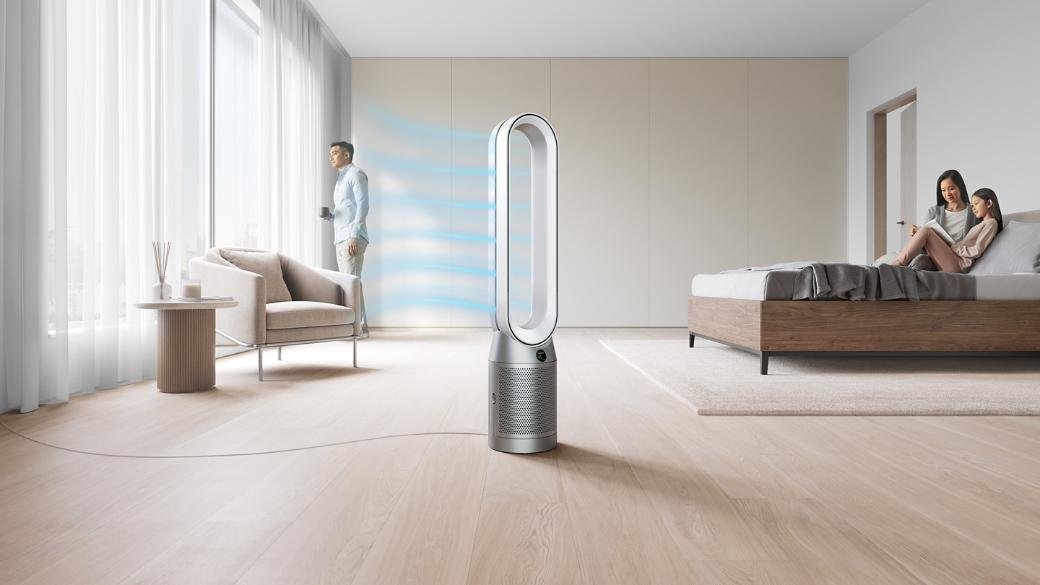
- Dyson Purifier Cool TP07 — A tower fan combined with a HEPA air purifier, so it cools and cleans the air at the same time. A good choice if you want one device to handle both warm air and dust or allergens, and its bladeless design is safe around kids and pets.
Frequently Asked Questions
How tall should a tower fan be?
Most tower fans are 30–48 inches tall. For a bedroom or desk area, 30–36 inches is enough. For a living room, choose 40 inches or taller so the airflow reaches across the room rather than stopping at knee height.
Are tower fans better than pedestal fans?
Tower fans take up less floor space, run quieter, and look better in a living room. Pedestal fans usually move more air and let you adjust the height. If floor space is tight or noise matters, choose a tower fan. If maximum airflow is the priority, a pedestal fan may cool more.
Do tower fans actually cool a room?
A fan does not lower the air temperature — it moves air across your skin, which makes you feel cooler. In a closed, very hot room, a tower fan alone will not match an air conditioner. It works best when paired with ventilation, such as an open window in the evening, or as a supplement to air conditioning.
How loud is a tower fan?
Most tower fans run between 35 and 60 dB depending on speed. Quiet models stay under 45 dB on low, which is suitable for a bedroom. Bladeless and DC-motor models are usually the quietest. Check the decibel rating at the speed you plan to use, not just the lowest setting.
As an Amazon Associate I earn from qualifying purchases.